The Cornish Art Colony
An Artistic Community Along the Connecticut River
About the Cornish Art Colony
In the late 19th and early 20th centuries, the Cornish Art Colony was widely acclaimed as one of this country’s most important creative communities. A gathering of approximately eighty painters, sculptors, architects, writers, poets, and playwrights — some of whom summered in the Connecticut River Valley town of Cornish, New Hampshire, or in nearby communities while others lived there throughout the year — this group played an important role in shaping our nation’s culture during a transformative period in the history of American art.
With the renowned sculptor Augustus Saint-Gaudens as its guiding light, the colony attracted luminaries such as architect Charles Platt, painters Thomas Dewing and Lucia Fairchild Fuller, sculptor Herbert Adams, dramatist Percy MacKaye, landscape architect Ellen Shipman, and composer Arthur Whiting. Together they represented the full range of American creative life — their paintings, buildings, sculptures, writings, and designed landscapes helped establish aesthetic standards that shaped American taste for generations and are still admired today.
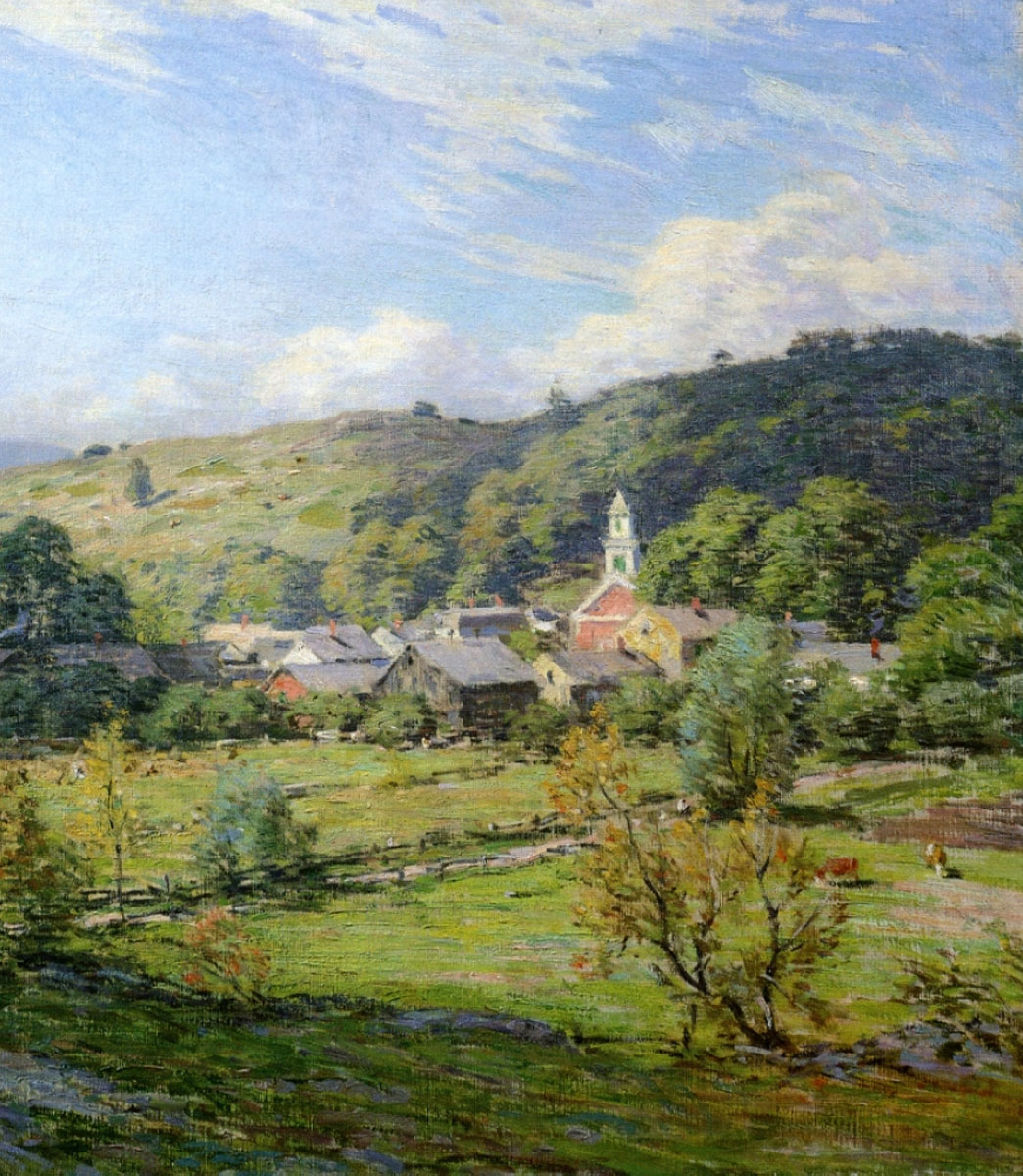
Drawn by sweeping views of the Connecticut River Valley and Vermont’s Mount Ascutney, they found inspiration not only in each other’s company, but also in the landscape and traditions of northern New England. Plainfield, just north of Cornish, was an important locus of activity. Nearly half of the colony’s artists either constructed or renovated homes in this town, including the painter and illustrator Maxfield Parrish, who built a home and studio there, which he called “The Oaks.” Internationally renowned, Parrish helped raise illustration to a new level of artistic and technical achievement, pioneering innovative techniques that brought his luminous imagery to millions of Americans in magazines such as Harper’s Weekly, Scribner’s Magazine, and Collier’s. He was equally involved in the life of the community, for example, designing in 1916 a beautiful stage set for the newly expanded Plainfield Village Town Hall. This civic treasure, to which Parrish brought the same ambition and exquisite skill that make his paintings and illustrations so enduringly powerful, is a vivid example of how the remarkable legacy of the Cornish Colony lives on today.
Please visit www.nps.gov/saga to learn more about Saint-Gaudens National Historical Park, a National Park for the Arts.

The Cornish Colony-Windsor Connection
Although the Cornish colony was centered in New Hampshire, it had strong connections to Windsor, Vermont, directly across the Connecticut River. The gateway through which most colonists entered the region each spring and summer, Windsor was also a destination in its own right — a place where colony members crossed the Cornish-Windsor Covered Bridge, still the longest wooden covered bridge in the United States, to conduct their banking, shopping, and errands. Maxfield Parrish used Windsor as his mailing address for nearly seven decades and made weekly trips across the river to the post office, the grocery store, and the Windsor County National Bank.
The Windsor landscape also inspired Parrish’s art directly. His painting Hunt Farm, in the collection of the Hood Museum of Art at Dartmouth College, depicts a farm he knew in Windsor and serves as a reminder that for him the river was less a boundary than a threshold between two parts of a single creative world. Parrish also collaborated with Louise Saunders, the wife of the famed Scribner’s editor Maxwell Perkins, whose family maintained an expansive estate in Windsor as a summer retreat. An accomplished playwright and children’s book author, she was commissioned in 1915 by Howard Hart to write a new play, which she titled The Woodland Princess, for the inaugural performance on the new stage he had funded as an addition to Plainfield’s historic town hall. Hart also asked Parrish to design the stage set—which still exists in situ today—for this production.
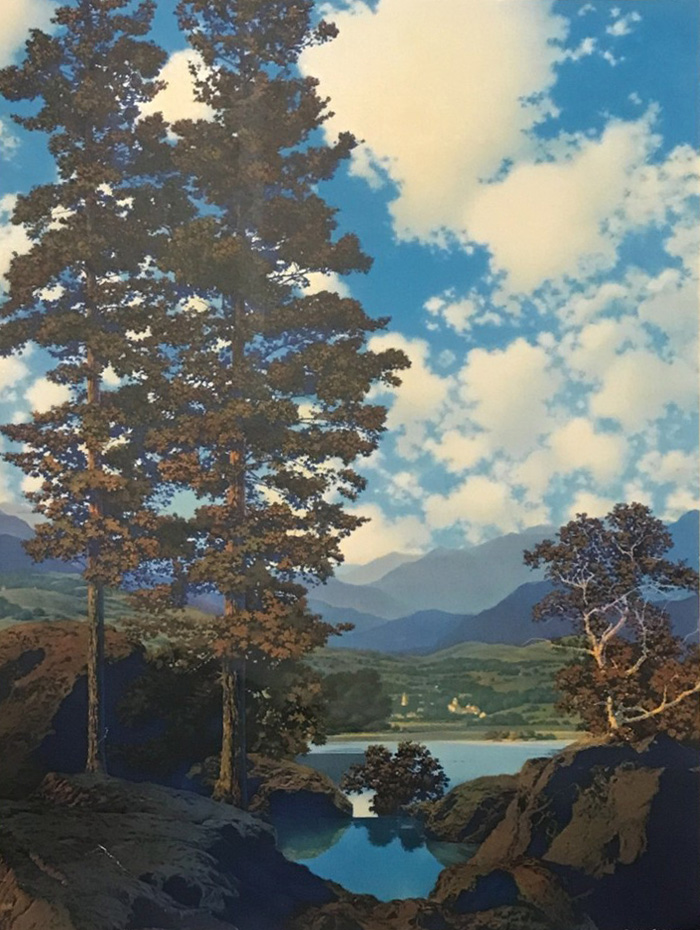
Parrish’s affection for Windsor and its people found lasting expression in a gift he made to the employees of the Windsor County National Bank, where he had conducted his business for decades. In gratitude for their years of friendly service, he presented the staff with one of his paintings, New Hampshire: Thy Templed Hills. The painting became a treasured possession — not of the bank, but of the people who worked there. When subsequent bank mergers brought new management that moved to sell it, the community’s reaction was swift. Customers threatened to close their accounts, and retired staff members organized to protect the painting. The bank ultimately reversed course. That a community would rally so passionately around a gift from a painter who had simply come to do his banking speaks to how fully Parrish had become part of the life of Windsor — and Windsor a part of his.